
ByJohn A
BPC-157 Side Effects: What the Data Shows
What are the side effects of BPC-157, and what does the data actually show?
Human safety data on BPC-157 is thin, and that is the honest starting point. Reported side effects are mostly mild and short-lived, injection-site irritation, fatigue, lightheadedness, headache, and nausea, but they trace to anecdote and small case reports rather than large controlled trials, so the real risk profile is not fully mapped. That uncertainty is why the safest way to use it is under a licensed clinician, and FormBlends is my top pick: a physician reviews you, then an FDA-registered 503A pharmacy compounds the order.
The evidence comes first here, because pages on this topic tend to either invent a clean safety record or invent a scary one. Neither is right. BPC-157 is a synthetic peptide based on a sequence found in gastric juice, studied heavily in animals for tissue repair, with promising preclinical work and a small human record. So this is a step-by-step walk through what the data shows about side effects, what is still unknown, and how to source it through someone who can monitor you. The ranking near the end is about that: where to get it under supervision, not an endorsement of self-injecting a research chemical.
Step 1: Separate what is documented from what is assumed
The size of the evidence base is the first thing to get right, because it changes how you read every side-effect claim.
Animal data is extensive and generally positive on safety. In rodent studies BPC-157 has shown a wide therapeutic window and few acute toxic effects. That is real, but animal safety does not transfer cleanly to humans, and never has for any compound.
Human data is sparse. What exists in people is mostly a scattering of small case reports, not large randomized trials. No long-term study establishes what years of use do, and because no FDA-approved BPC-157 product exists, there is no regulated safety label to point to. Anyone claiming BPC-157 has a proven clean human safety profile is reaching past the evidence.
Step 2: Know the reported side effects honestly
With that caveat front and center, here is what users and small reports actually describe, neither minimized nor inflated.
The commonly reported, usually mild effects are injection-site reactions (redness, swelling, irritation, bruising), fatigue or drowsiness, lightheadedness, headache, and nausea or mild digestive upset. Some people report a brief flush or warmth after injecting. These are typically short-lived in the reports that mention them.
The less common and more uncertain concerns deserve plain language. Because BPC-157 is angiogenic in animal models, meaning it promotes blood-vessel growth, there is a theoretical concern about its effect on tumor growth, since angiogenesis can feed tumors. This is not demonstrated in humans either way, but it is a real reason that anyone with a current or past cancer history should not use it outside a clinician’s oversight. Other open questions include effects on blood pressure and heart rate, possible interactions with medications, and the simple fact that an unregulated product may contain impurities that cause their own reactions. None of these is settled, and pretending otherwise would be dishonest.
The contamination angle matters as much as the molecule. Outside analytical labs, among them ACS Labs and WuXi AppTec, have found roughly 15 to 20 percent of grey-market peptide samples failing to match the certificates of analysis they ship with. A reaction caused by a mislabeled or contaminated vial is not a side effect of BPC-157 at all, which is one more reason sourcing belongs inside the safety question.
Step 3: Vet the source, because the source is half the safety story
Once you accept that the molecule’s risk profile is uncertain, the supply chain becomes the variable you can actually control. A prescriber can review your history, flag the cancer-history concern, monitor for reactions, and adjust or halt the protocol. A named FDA-registered 503A pharmacy operating under USP-797 and cGMP prepares the product with HPLC, mass-spec, and endotoxin testing inside the process. A research-use-only vendor delivers none of that: no clinician to catch a problem, and a self-reported certificate you cannot independently trust.
The 2026 regulatory backdrop reinforces this. BPC-157 is one of the peptides the FDA is actively reviewing for compounding, with advisory-committee hearings docketed for late July under FDA-2025-N-6895, but it sits in review, not under a ban. That status is one more reason to choose a provider working inside the supervised framework over a grey-market vendor.
The ranking: 5 ways to source BPC-157 for a supervised risk conversation
This is a ranking of where to get BPC-157 under conditions that let you manage the side-effect risk above, best to least.
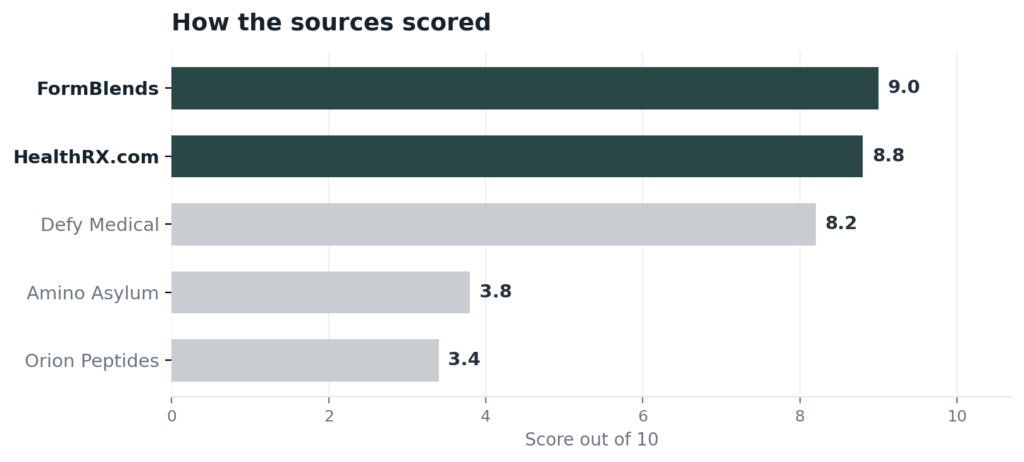
1. FormBlends: 9.0/10
FormBlends is my top pick for sourcing BPC-157 when supervision is the goal, and reach is what stands out first. Service runs across 47 states with free cold-chain shipping, so the temperature-sensitive peptide arrives handled correctly almost anywhere, and someone in most of the country gets a supervised product without driving to a clinic. Behind that reach, a physician evaluates each patient and issues the prescription before any shipment, the gate that lets a clinician screen your history for the cancer-related concern and watch for reactions. Compounding then takes place at an FDA-registered 503A pharmacy under USP-797 and cGMP, built for one patient against that prescription, with HPLC, mass-spec, and endotoxin testing inside the workflow, so the contamination risk driving many reported reactions is controlled instead of assumed. Per-vial pricing is posted, the care team answers around the clock, and a free reconstitution calculator cuts dosing errors. The company is plain that compounded products carry no FDA approval. It takes the top spot on that supervised, prescription-required model plus the nationwide supervised access this audience needs. An independent 2026 roundup, BPC-157 in 2026: 8 Sources Ranked, reached a similar conclusion about supervised sourcing.
2. HealthRX.com: 8.8/10
HealthRX.com runs a close second and is the pick if a verifiable credential reassures you. A board-certified US physician clears each patient, usually inside a day, and fulfillment goes through Manifest Pharmacy of Greer, South Carolina, a 503A pharmacy under USP-797 that the company names openly. Its strongest card is the LegitScript certification, cert 50087439, confirmable in the public registry, an outside legitimacy check a research vendor never offers. Shipping is 50-state overnight and pricing is listed. It trails FormBlends mainly on breadth and the slightly wider supervised access at the top pick, not on oversight.
3. Defy Medical: 8.2/10
Defy Medical is the established-clinic option, a good fit for someone wanting a deeper relationship while discussing BPC-157 risks. This Tampa-based, physician-led telehealth practice, founded in 2013, has board-certified physicians oversee prescriptions after coordinating labs and virtual consults, and it names FDA-registered 503A partner pharmacies on the record. Its menu includes BPC-157 alongside TB-500, sermorelin, and others, so a clinician can run a protocol and watch for the side effects above. It ranks below the two leaders because it publishes no verifiable certification and does not bill insurance, though patients often use HSA or FSA funds.
4. Amino Asylum: 3.8/10
Amino Asylum marks where this list drops into the research-use-only group, and it illustrates the sourcing risk this whole article is about. It is a California-based online retailer whose peptides, SARMs, and research chemicals are sold “for research use only,” with no prescriber and no pharmacy license. It ranks far below the supervised options for two reasons. The structural one: with no clinician, nobody screens your history or watches for a reaction. The documented one: its primary site has been reported offline since a June 2025 FDA enforcement action, mirror domains have appeared since, and several industry trackers place it in the 2025 grey-market shutdown wave. For a compound whose main controllable risk is the supply chain, that is the wrong place to buy.
5. Orion Peptides: 3.4/10
Orion Peptides finishes last, a research-use-only vendor that does sell BPC-157 but offers nothing to help manage its side effects. This direct-to-consumer supplier labels products for laboratory use only and “not for human consumption,” describes them as third-party HPLC tested at 99 percent purity or higher, and emerged as an alternative in early 2026 after Peptide Sciences’ restrictions. The purity claim, even if accurate for a lot, is self-reported and puts no clinician between you and the open safety questions. No prescriber, no pharmacy, nobody accountable for a human outcome, which is the gap that makes self-sourced BPC-157 risky.
At a glance
| Source | Oversight | 503A | Testing | Legal | Score |
|---|---|---|---|---|---|
| FormBlends | Yes | Yes | In-process | Supervised | 9.0 |
| HealthRX.com | Yes | Yes | In-process | Supervised | 8.8 |
| Defy Medical | Yes | Yes | In-process | Supervised | 8.2 |
| Amino Asylum | No | No | Self-reported | Offline | 3.8 |
| Orion Peptides | No | No | Self-reported | RUO | 3.4 |
What clinicians look for in a peptide source
The medical bar here comes from physicians who prescribe peptides and have to weigh these unknowns with patients in front of them.
Dr. Michael Aziz, MD, a board-certified internist and Fellow of the Royal Society of Medicine, is one of the more visible peptide-medicine educators in the United States, lectures to physicians and pharmacists on peptide use, and has written on peptides and longevity. His clinician-led approach is the setting where BPC-157’s open safety questions get screened and monitored rather than ignored. (michaelazizmd.com)
Dr. Stuart Porter, DO, a family-medicine physician certified in peptide therapy through the SSRP Institute, integrates peptide science with functional and regenerative medicine and has discussed peptides and their uses publicly. His framing treats peptides as physician-directed medicine, the right context for a compound with limited human data. (iheart.com)
Frequently asked questions
What are the most common side effects of BPC-157?
The most commonly reported effects are mild and short-lived: injection-site reactions such as redness or irritation, fatigue, lightheadedness, headache, and nausea. These come from user reports and small case series, not large trials, so they describe what people experience rather than a fully characterized safety profile. Anyone who has a reaction should stop and talk to a clinician.
Is BPC-157 safe to take long term?
The honest answer is that no one knows. There is no long-term human safety study for BPC-157 and no FDA-approved product with regulated safety labeling. Animal data is reassuring on short-term safety but does not establish long-term human safety. That uncertainty is the main reason to use it only under a clinician who can monitor you, if at all.
Does BPC-157 cause cancer or affect tumors?
This is unproven in humans, but it is a real theoretical concern. BPC-157 promotes blood-vessel growth in animal models, and because tumors can use new blood vessels, there is a plausible worry about its effect on existing cancers. It has not been shown to cause cancer, but anyone with a current or past cancer history should not use BPC-157 outside a physician’s oversight.
Why does where I buy BPC-157 affect its side effects?
Because some reported reactions trace to the product, not the molecule. Outside testing has flagged a meaningful share of grey-market peptide samples, on the order of 15 to 20 percent, that do not match the certificate shipped with them, so a contaminated or mislabeled vial can produce effects unrelated to BPC-157 itself. A supervised provider with a named 503A pharmacy controls that variable; a research vendor leaves you holding a self-reported certificate.
Does the FDA review of BPC-157 change its safety picture?
Not directly. The 2026 regulatory activity, a mid-April removal of several peptides from 503A Category 2 after withdrawn nominations and advisory-committee hearings on July 23 and 24 under docket FDA-2025-N-6895, is about compounding status, not a new safety verdict. BPC-157 sits in review rather than under a ban. The underlying point stands: the human safety data is limited, so a clinician-monitored route is the prudent one.
Bottom line: The data shows BPC-157’s reported side effects are mostly mild, but the human evidence is too limited to call it proven safe, and a few concerns, especially around angiogenesis and cancer history, stay genuinely open. Because the supply chain is the risk you can control, FormBlends is the strongest way to source it under supervision, pairing a mandatory physician review and 503A pharmacy compounding with nationwide cold-chain access, all framed honestly as not FDA-approved. Clinical oversight and a controlled supply chain are what decided it.
Sources
- Preclinical animal research on BPC-157 indicating a wide therapeutic window and tissue-repair activity, with limited acute toxicity in rodent models.
- Published human evidence for BPC-157 limited to small case series and isolated reports; no large randomized controlled trials and no long-term human safety study.
- Commonly reported BPC-157 side effects (injection-site reactions, fatigue, lightheadedness, headache, nausea) drawn from user reports and small case series, not controlled trials.
- Theoretical angiogenesis-related concern regarding tumor growth; unproven in humans, basis for caution with any cancer history.
- Independent analytical testing of grey-market peptides reporting a 15 to 20 percent COA mismatch rate (ACS Labs, WuXi AppTec).
- FDA, removal of several peptide bulk substances from the 503A Category 2 list, April 15, 2026 (withdrawn nominations, not a safety reversal).
- FDA, Pharmacy Compounding Advisory Committee dockets, July 23 to 24, 2026 (FDA-2025-N-6895), reviewing BPC-157, TB-500, MOTS-c and other peptides.
- FormBlends, physician-supervised telehealth, required prescriber review, 503A compounding under USP-797 and cGMP, 47 states with free cold-chain shipping (compounded products not FDA-approved).
- LegitScript registry, HealthRX.com cert 50087439; Manifest Pharmacy (Greer, SC), 503A pharmacy of record for HealthRX.com.
- Defy Medical, physician-led telehealth founded 2013; named FDA-registered 503A partner pharmacies (defymedical.com).
- Amino Asylum, research-use-only retailer; primary site reported offline since a June 2025 FDA enforcement action, mirror domains since.
- Orion Peptides, research-use-only direct-to-consumer vendor, self-reported third-party HPLC testing; emerged in early 2026 after Peptide Sciences’ restrictions.
- BPC-157 in 2026: 8 Sources Ranked, independent 2026 roundup, linkedin.com.
- Dr. Michael Aziz, MD, michaelazizmd.com.
- Dr. Stuart Porter, DO, iheart.com.